
Remote monitoring or manual checks: It is not necessarily an either-or decision
Wastewater services specialist PDAS Group looks at how remote monitoring works alongside manual inspections in the management of today’s pumping stations
It’s strange how something as ordinary as a pump station can end up deciding whether a site runs smoothly or falls into chaos. Systems that looked fine one morning suddenly show a high-level alarm by the afternoon, and it always raises the same question: Should we still rely so heavily on traditional manual checks when remote monitoring exists?
Pump station management has changed, and it’s still changing, so what is the difference between remote monitoring and manual checks?

Manual checks are exactly what they sound like. An engineer or site operator drives out, opens the covers, listens for unusual sounds, maybe runs a test cycle, and notes anything unusual. There’s something reassuring about seeing the equipment in person, even feeling the pumps’ vibration through the housing.
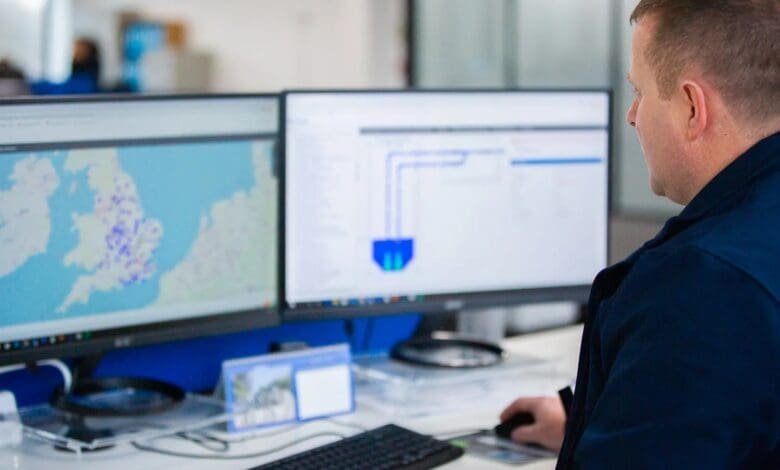
Remote monitoring, though, is a different rhythm entirely. Instead of visiting the site, continuous data streams come from sensors and pump control systems. Performance metrics, pump run hours, level changes, temperature spikes; all delivered instantly.
Some providers have mentioned that 2025 has seen around a 12–15% rise in the adoption of remote pump station monitoring compared with last year, which makes sense. People want fewer surprises.
Still, the core difference is availability. Remote monitoring runs 24/7. Manual checks happen whenever someone can get there.
So how can remote pump station monitoring improve reliability? The simplest answer is by noticing things humans miss. Not out of negligence, just because people can’t watch a system all day.
Remote monitoring catches the very early signs of pump wear or level sensor failure. A remote monitoring system might show a pump taking slightly longer to empty a wet well, or maybe the temperature creeping up during one cycle.
These aren’t things most people would spot in a one-hour inspection window.
And reliability doesn’t just mean avoiding breakdowns. It also means avoiding unnecessary callouts. One engineer PDAS works with has commented that since they moved to a remote system, the number of false alarms on their sites has dropped noticeably. Maybe that sounds small, but false alarms eat into budgets and patience.
It also helps that many remote monitoring dashboards now integrate directly with pump control systems, so it’s not just about seeing problems; it’s about acting on them faster.
The biggest drawback of relying solely on manual inspections is timing. Problems don’t wait for the weekly or monthly inspection round. So while manual checks can feel thorough, they offer only a snapshot. If something goes wrong two hours after the engineer leaves, the station sits unmanaged until the next visit or alarm.
And not all alarms are obvious unless you’re there to see the signs: the float switch that sticks occasionally, the pump that sounds a bit rough, the seal that’s just beginning to fail.
There’s also the travel factor. Some pump stations are far from main roads. Delays happen. The weather gets in the way. Pumps don’t care about any of this; they continue running until something overheats.
Interestingly, recent maintenance data showed that about 30% of emergency pump repairs were linked to issues that developed between routine manual checks. That’s a lot of avoidable downtime.
Pump control systems
Pump control systems sit at the centre of everything. They act as the brain of the whole operation, coordinating when and how pumps start and stop, distributing load, and preventing overflows.
What is particularly interesting is that modern systems don’t just automate; they adapt. If one pump is struggling, the system can shift demand to the other. If run-hours are uneven, it can rebalance workloads.
Remote monitoring becomes far more useful when paired with these intelligent controls. Together, they offer not just visibility but action. You’re not stuck watching a graph rise; the system can react before a site operator even checks their dashboard.
It’s not perfect, of course. No automatic system replaces human judgment entirely. But it makes the job lighter and, quite honestly, safer.
Remote monitoring can’t eliminate every emergency, but it does reduce the frequency quite a bit. Small issues, such as an unusual vibration reading or a rising motor temperature, can be flagged before they escalate.
Some specialists estimate that remote monitoring can prevent roughly 40–50% of potential emergency pump repairs simply by catching early indicators.
Even something as simple as a partially clogged impeller can be detected earlier because the pump’s current draw begins to spike. In manual inspections, unless someone happens to check at the exact moment, the issue goes unnoticed.
Benefiting from 24/7 remote monitoring
The biggest change is peace of mind knowing that even if the site is unattended, the system is still watched. That matters, especially for new-build pump services, where reliability forms part of the project’s long-term handover.
Then there are the practical benefits, such as fewer emergency call-outs, faster fault diagnosis, more predictable pumping station maintenance schedules and better compliance reporting. Plus, of course, earlier warnings before costly failures and reduced site visits, which can also cut costs.
What sometimes gets overlooked, though, is the planning benefit. When data accumulates over months, patterns emerge. You can see which pumps work hardest, which sensors drift, and when seasonal changes affect inflow. And this helps shape future decisions in a way manual checks simply can’t.
Oddly enough, the more data businesses get, the less reactive they become. Problems stop feeling like surprises.
Conclusion
Remote pump station monitoring doesn’t replace human involvement, and perhaps it shouldn’t. Manual checks still catch things technology misses: smells, sounds, the feel of a pump that’s just not right. But relying on manual inspections alone leaves too many gaps.
Modern pump control systems and remote monitoring close most of these gaps and make pump station management noticeably smoother. Not perfect, but far more reliable.
And considering how disruptive an emergency pump repair can be, having round-the-clock visibility feels less like an upgrade and more like something everyone will eventually rely on by default. Stay ahead of faults before they become failures.
Click here for more information