
Troublesome train toilet waste pumping station gets back on track

An innovative mixing solution from Landia has solved a long-standing issue at a troublesome pumping station that receives wastewater from trains in the South of England.
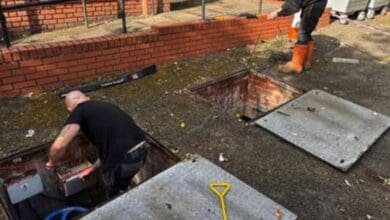
At the railway facility’s pumping station, the existing duty pump in the 30m3 chamber kept blocking: unable to fully deal with the solids from trains’ toilets, which, over time, greatly reduced the site’s capacity.
“When we first visited the pumping station, I couldn’t quite believe the volume of accumulated solids,” said Landia’s Howard Burton.

“But on the other hand, knowing what some people still unfortunately consider fair game to flush down a public toilet, it perhaps wasn’t that much of a surprise at all.
“The point is that standard duty pumps can’t really handle this type of application, and the resulting hassle, downtime, reduced capacity and greatly increased maintenance costs are inevitable.”
The situation had in fact become so bad with the non-liquid waste from the railway network’s controlled emission toilets (CETs) that staff had had to resort to manually addressing the build up of solids with rakes.
“Our customer had looked at options for various twin-shaft grinders, but found the costs prohibitive,” added Howard.
“Grinders certainly have their place, but costs aside, this was for us, a case of not needing a sledgehammer to crack a nut – and that with our simple EradiGator system, a viable and affordable solution was at hand.
“There are continuous passes through our proven Chopper Pump’s external knife system, whereas with a grinder, there will be one single pass. In this tough application, we included our shredder propeller, which is proving increasingly popular.”
Following the installation of its freestanding system at the railway facility’s pumping station, the existing duty pump has effectively been protected, able to pump wastewater again without blocking. Meanwhile, the Landia system gets to grips with the main task of reducing the particle sizes of the invading solids, so that the lift/pumping station can operate as it is meant to. “Another advantage of our tailored solution,” continued Howard, “is that it requires no additional infrastructure. It’s a drop-in, plug-and-play solution. Also, everything is set up on a timer, with just 15 minutes per hour required, meaning low energy costs from a 5.5kW (7.3HP) motor, and a much easier system all round for our customer.”