
Precision mass flow control restores yield in polyurethane production
When a UK polyurethane manufacturer faced persistent quality losses across two production lines, its machine builder, CTM (UK) Ltd, turned to UK Flowtechnik to resolve a metering challenge that conventional technology could not address.
The issue faced by the polyurethane manufacturer was not marginal. For years, the end-user had struggled with inconsistent filling of production tools, resulting in voids, cosmetic defects, and a low yield of acceptable parts. The product was highly visual, making even minor imperfections commercially unacceptable. High scrap rates were constraining throughput, yet demand was rising. New orders required increased production output at a time when the existing process was already under strain.
A metering problem at the heart of quality loss
CTM UK Ltd, based in Barnsley, South Yorkshire, specialises in the design, build, and repair of polyurethane metering machinery. As an original equipment manufacturer (OEM) the company was tasked with designing a new machine capable of stabilising and improving the customer’s process.

At the core of the issue was inaccurate metering and mixing. The two-part system – polyol and isocyanate – required precise control to achieve consistent material properties. However, the polyol stream presented a particular challenge: it contained 62% calcium carbonate solids. This high solids loading created significant measurement difficulties for traditional mechanical flow meters.
Mechanical meters introduced the risk of separating solids from the carrier fluid, potentially leading to build-up, measurement drift, and further instability in the process. In a system where linearity of ±0.5% or better was required, this was not acceptable. Reliability was equally critical, as frequent recalibration and adjustment were contributing to downtime and operator intervention.
Coriolis technology
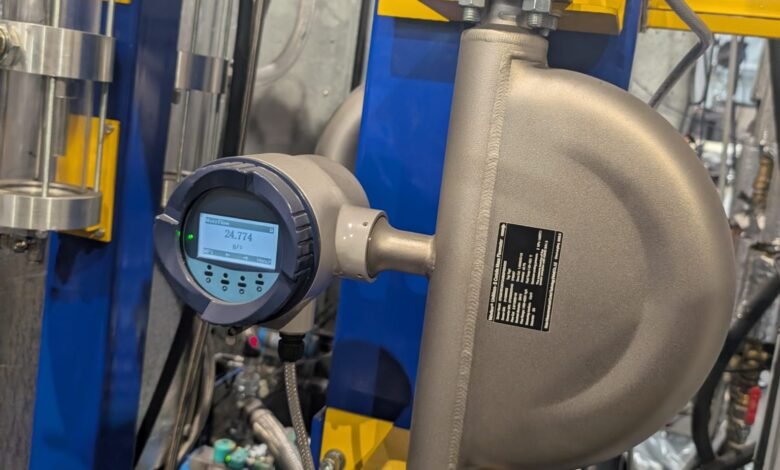
To meet these requirements, UK Flowtechnik supplied four Coriolis mass flow meters: two Unimass CFS-S030I-15S ½-inch units and two Unimass CFS-S030-40S 1½-inch units. The technology choice was deliberate.
Unlike mechanical meters, a Coriolis mass flow meter contains no internal components that obstruct the flow. The design consists of two vibrating tubes through which the fluid passes. As material flows through the tubes, the Coriolis effect induces a phase shift proportional to the mass flow rate. Sensors detect the time difference between vibration points, converting it directly into an accurate mass flow measurement.
For a fluid containing a high proportion of suspended solids, this approach offers a significant advantage. The absence of mechanical obstructions reduces the risk of separation or internal build-up, while direct mass measurement avoids dependence on fluid properties that may vary during operation.
In this application, the robustness of Coriolis measurement enabled accurate, repeatable control of both polyol and isocyanate streams, even under demanding conditions.
CTM integrated the Unimass meters into a newly built machine at its workshop before commissioning on site using live chemical materials. Installation, commissioning, and start-up proceeded without complication.
Accurate metering was achieved immediately. Good saleable parts were produced from the second test fill, and the first full production run yielded more acceptable parts than had previously been achieved on either of the existing lines.
The impact extended beyond initial performance. Historically, operators had spent many hours per shift fine-tuning process controls in an attempt to maintain quality. With the new system, daily calibration and continual adjustment became unnecessary. The process stabilised to the point where operators could focus on production rather than corrective intervention.
Measurable gains
The improvement in consistency addressed the root cause of scrap generation: inaccurate proportioning and mixing. By delivering linearity within the required tolerance and maintaining stable measurement despite the abrasive, solids-laden fluid, the Unimass Coriolis meters removed a major source of process variability.
The operational benefits were both quantitative and qualitative. Scrap levels were reduced, throughput constraints were relieved, and the customer was able to respond to increased demand. At the same time, maintenance interventions declined, and unplanned downtime associated with recalibration was eliminated.
For CTM, the success of the installation reinforced the viability of specifying Coriolis mass flow technology in applications that might previously have been considered too challenging due to solids content. For UK Flowtechnik, the project expanded its proven capability within polyurethane processing, including applications involving heavily filled polyol systems that would once have been declined.
The result was not simply a component supply, but a measurable process improvement: accurate mass flow control enabling consistent product quality in a demanding production environment.