
Ball valves or gate valves: which one is right for your system?
Fluid control specialist, Valvenok, offers a comparison of ball valves and gate valves, outlining their key differences, types, advantages, and important replacement considerations, helping you make the right choice for your applications.
In fluid control systems, selecting the right valve is not just a technical decision; it directly influences system performance, operational safety, energy efficiency, and long-term reliability. Among the most frequently evaluated options are ball valves and gate valves, two widely used solutions across industrial applications.
Although both are designed to control flow, their internal design, operating mechanism, and performance characteristics differ significantly. Understanding these differences is essential to ensuring optimal valve selection for your specific application.

There is no single valve that is universally better; the correct choice depends entirely on the system requirements and operating conditions. That said, in many modern industrial applications, ball valves are increasingly favoured for their reliable sealing, quick quarter-turn operation, and reduced maintenance requirements. Their design makes them particularly suitable for systems where efficiency, safety, and responsiveness are critical.
Ball valves are ideal for quick shut-off applications, systems requiring tight sealing or frequent operation cycles, along with automated systems and space-constrained installations.
Alternatively, gate valves are particularly suited to Full-open or full-close applications, large-diameter pipelines, systems requiring minimal pressure drop and applications where the valve remains open or closed for long periods.
In high-performance and frequently operated systems, ball valves often deliver superior reliability and operational efficiency compared to gate valves.
Types of ball valves
Selecting the correct ball valve type is essential to ensuring optimal performance, durability, and system efficiency. Different designs are engineered to meet specific pressure ratings, flow requirements, and operational demands.
There are four primary types of ball valves used in industrial applications:
Floating-ball valves are widely used for their simple design, effective sealing, and economic value.
In a floating-ball design, the ball is not mechanically fixed; it is supported by the valve seats. Under line pressure, the ball shifts slightly downstream, pressing firmly against the seat to create a tight seal. They are recommended for low- to medium-pressure systems, general industrial service, water, gas, and non-critical process applications, and cost-sensitive projects.
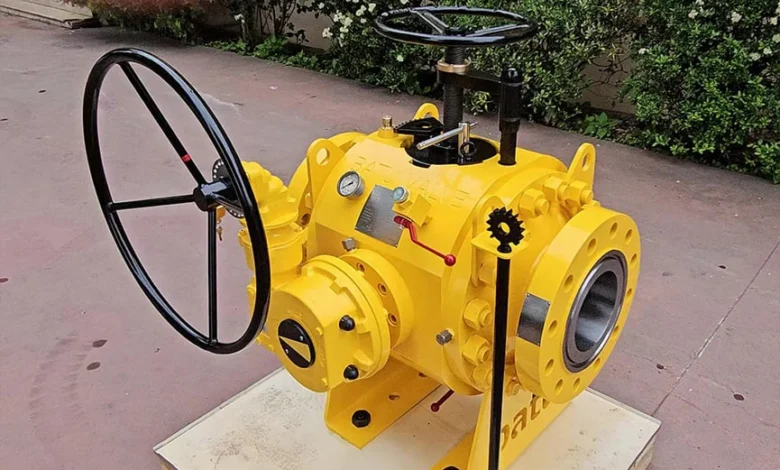
Trunnion-mounted ball valves provide enhanced stability, durability, and performance in demanding environments.
In this configuration, the ball is anchored by trunnions (mechanical supports) at both the top and bottom. This reduces the load on the valve seats and lowers operating torque, especially in high-pressure conditions.
This type of ball valve is particularly suited tohigh-pressure and high-temperature systems, large-diameter pipelines, oil and gas transmission lines and heavy-duty industrial applications.
Full port ball valves feature an internal bore diameter equal to the pipe diameter, allowing unrestricted flow through the valve. This design offers advantages, including minimal pressure drop, maximum flow capacity, and reduced turbulence. They are ideal for pigging operations and other scenarios where maintaining full flow efficiency is critical.
Reduced port ball valves, which have an internal bore slightly smaller than the pipeline diameter, resulting in a modest reduction in flow area.
They are, however, more compact and lightweight than similar alternatives and typically cost less than full-port valves. They are ideal where minor pressure loss is acceptable and are commonly selected when space, weight, or budget considerations are important.
Advantages of a ball valve
Ball valves offer several technical and operational advantages over traditional gate valves. Their simple design and high-performance efficiency make them a preferred choice in many modern fluid control systems.
Ball valves operate with a simple 90-degree rotation from fully open to fully closed. This quick actuation enables rapid shut-off, particularly valuable in emergency or high-risk situations.
Designed for tight shut-off, ball valves offer reliable, bubble-tight sealing. They maintain sealing integrity even after long periods of inactivity, minimising the risk of leakage.
With fewer internal moving parts than gate valves, ball valves wear less and require minimal maintenance. This translates into reduced operational downtime and lower lifecycle costs.
Ball valves are engineered to withstand demanding operating conditions, including high pressure and elevated temperatures, while maintaining consistent performance.
While their streamlined construction allows for easier installation in confined spaces. Compared to gate valves, ball valves are generally lighter and require less installation clearance.
Finally, ball valves are well-suited to automation. Their quarter-turn mechanism integrates seamlessly with electric, pneumatic, and hydraulic actuators, making them ideal for modern automated systems.
From a modern engineering standpoint, ball valves are generally preferred for on/off applications due to their reliability, ease of operation, and superior sealing performance.
Gate valves, however, remain suitable in applications where full-bore, unobstructed flow is essential, where the valve will remain either fully open or fully closed for extended periods, or where throttling or flow regulation is not required
However, in systems that demand greater operational flexibility, enhanced safety, and consistent performance, ball valves typically offer superior overall advantages compared to gate valves.
Interchangeability
The question of whether a gate valve can be replaced with a ball valve often comes up. In many cases, replacement is feasible, but it requires a careful technical evaluation.
A gate valve can be replaced with a ball valve when the application involves strictly on/off control, pressure and temperature ratings are compatible, the pipe sizing and connection standards align and throttling or flow regulation is not needed
However, it is essential that flow characteristics and behaviour are examined alongside the potential impacts from pressure drops. Plus, the replacement valve must comply with the system’s design standards and be compatible with the conveyed media.
Engaging a valve specialist is recommended to ensure that any replacement preserves system integrity and meets all operational and regulatory requirements.
Conclusion
Both ball valves and gate valves have their place in fluid control systems. The key is selecting the right valve based on operating pressure, temperature conditions, flow requirements, frequency of operation and automation needs
At Valvenok, we emphasise engineering-driven valve selection to ensure optimal system performance, safety, and longevity. Choosing the right valve is not just about function, it’s about long-term operational efficiency.
If you are evaluating valve upgrades or considering replacing gate valves with ball valves, professional guidance ensures the right decision for your system.
Click here to find out more